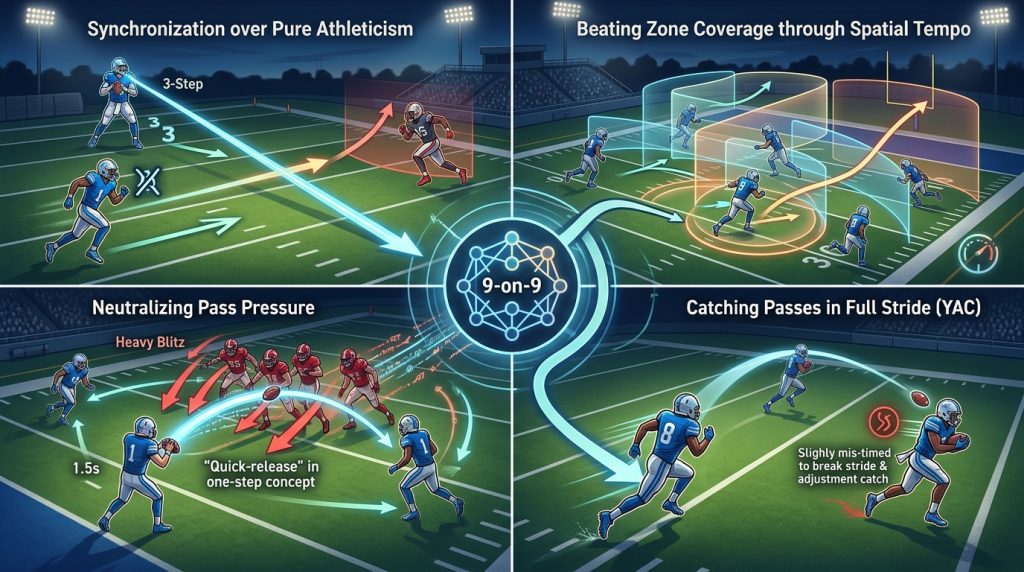
In 9-on-9 football, raw speed can grab attention, but rhythm and timing win games. With fewer defenders on the field, spatial windows open and close in fractions of a second. A 4.4-second sprinter running an out-of-sync route will consistently get shut down by disciplined defenders, whereas a precise receiver running a perfectly timed route creates unguardable throwing lanes every single time.
Precision Synchronization Over Pure Athleticism
Offenses that rely exclusively on outrunning defenders frequently stall against disciplined zone schemes. Synchronization between the quarterback’s footwork and the receiver’s route tree creates explosive plays regardless of raw foot speed.
Tying Quarterback Dropbacks to Route Breaks
A high-functioning 9-on-9 passing attack operates on strict timing mechanics where the ball leaves the quarterback’s hands before the receiver makes their break.
Hitting the Final Step Plant
When a quarterback takes a three-step drop, the ball must be in the air the instant their back foot plants. Throwing on rhythm prevents defensive backs from reacting to the pass in flight.
Exploiting Defensive Back Reaction Delays
Defenders react to movement rather than anticipating it. Throwing on precise timing steals crucial milliseconds of reaction time from the secondary.
Throwing into Anticipation Windows
Anticipation allows a passer to throw into an empty patch of grass, trusting that the receiver will break into that exact window right as the ball arrives.
Neutralizing Heavy Pass Pressure with Rhythm Throws
With nine players on the field, defensive coordinators frequently dial up aggressive five- and six-man blitzes to overwhelm the offensive line. Speed cannot save a play if the quarterback is sacked before a deep route develops.
Beating the Pass Rush with Quick-Release Concepts
Operating a high-tempo, quick-game package renders the opposing pass rush completely useless.
Executing One-Step Releases
Slants, hitches, and quick flat routes require the ball to come out in under 1.5 seconds, denying edge rushers any opportunity to collapse the pocket.
Creating High-Percentage Yards After Catch (YAC)
Delivering the ball on time allows receivers to catch passes in stride with their hips turned upfield, maximizing momentum.
Catching Passes in Full Stride
A receiver catching a perfectly timed ball in stride gains instant yards before the secondary can close the gap, turning a five-yard pass into a twenty-yard gain.
Beating Zone Coverage Through Spatial Tempo
Zone defenses thrive on lateral movement and closing speed. Timing disrupts zone responsibilities by delivering the ball into coverage voids before zone defenders can shift.
Stressing Zone Boundary Transfers
Zone coverages rely on passing receivers off from one defensive layer to the next as routes progress.
Hitting Soft Gaps Between Zone Layers
Timing throws hit the exact moment a receiver exits one defender’s zone and enters another’s, catching the defense mid-transition when responsibility is most vulnerable.
Establishing Cadence Discipline to Freeze Linebackers
Varying the snap count and play rhythm keeps second-level defenders on their heels, stripping away their ability to jump route concepts early.
Freezing Second-Level Linebackers
A sharp, disciplined snap cadence forces linebackers to pause for a split second to confirm the play, opening up massive passing windows right behind them.

Leave a Reply