Choosing the right defensive scheme in 9-on-9 football depends heavily on your team’s athleticism, communication, and field dimensions. Unlike traditional 11-on-11 football, removing two players opens up significant grass while keeping full passing concepts intact. Both Man and Zone coverage offer distinct advantages, but determining which works “better” comes down to how your defense balances physical match-ups against spatial coverage.
The Case for Man Coverage
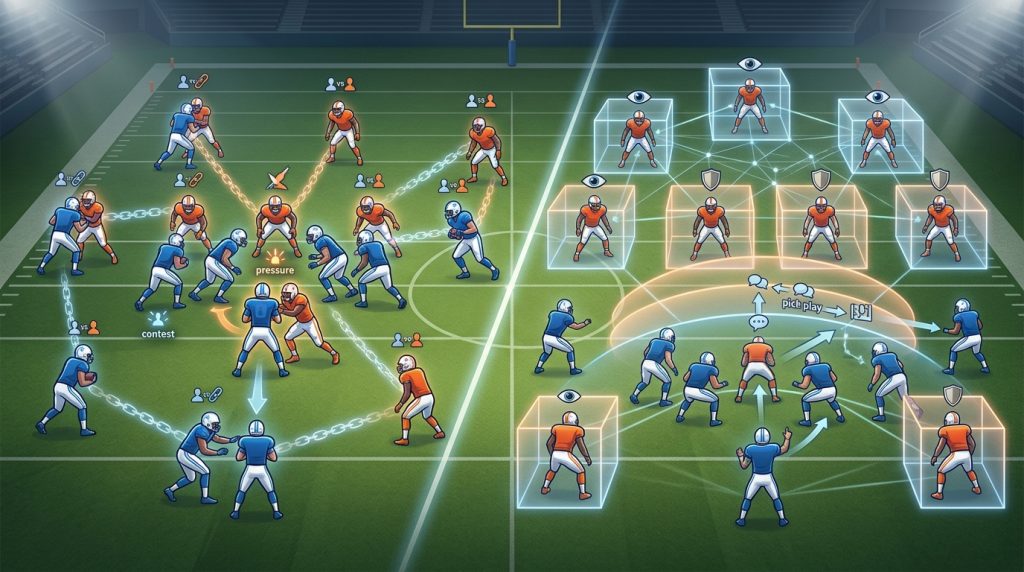
Man coverage simplifies responsibilities by assigning every defender a direct matchup. In 9-on-9, where space is vast, playing tight man-to-man can disrupt the offense’s timing and force immediate pressure.
Aggressive Disruption at the Line
Pressing receivers at the line of scrimmage prevents quick-rhythm throws and forces quarterbacks to hold the ball longer.
Maximizing Pass Rush Effectiveness
With nine players on the field, bringing extra pressure leaves fewer defenders in coverage. Man coverage allows blitizing schemes to rush five or six players while maintaining individual coverage on all eligible receivers.
Eliminating Zone Flaws and Soft Spots
Zone defenses naturally leave soft voids between defenders. Man coverage eliminates these open spaces by forcing tight 1-on-1 contests across the entire field.
Exploiting Superior Athletic Mismatches
If your secondary features elite DBs who can match the speed and agility of opposing receivers, man coverage forces the offense into contested, low-percentage throws.
The Case for Zone Coverage
Zone coverage prioritizes field coverage over individual match-ups. Defenders guard specific regions of the field rather than tracking a single player, making it an exceptional defense against pick plays and scramble drills.
Protecting Against Explosive Plays
By keeping defenders’ eyes turned toward the quarterback, zone systems limit deep vertical strikes and keep the play in front of the secondary.
Neutralizing Rub Concepts and Pick Routes
Offenses rely on crossing routes to rub man-to-man defenders into each other. Zone coverage counters this completely, as defenders simply pass receivers off through their designated zones.
Supporting the Run and Short Games
Zone linebackers can read the quarterback’s eyes and flow instantly toward perimeter screens or interior run lanes.
Capitalizing on Quarterback Mistakes
Defenders reading the passer’s eyes can jump early on telegraphed throws, resulting in high turnover rates through interception return yards.
The Final Verdict: Match Matchups with Field Context
Neither coverage scheme is inherently superior; the best defenses utilize a hybrid approach tailored to game situations.
- Use Man Coverage: On third-and-short, red zone possessions, or when bringing heavy blitz packages to disrupt the quarterback’s timing.
- Use Zone Coverage: On long-yardage situations, against heavy pre-snap motion teams, or to protect against big vertical plays late in the game.

Leave a Reply