
Operating in the red zone requires extreme precision. As the field shrinks near the end zone, defenders no longer have to guard the deep portion of the field, creating tightly congested passing lanes and heavy defensive traffic. In 9-on-9 flag football, where spatial dynamics are already dense with eighteen players on the turf, offensive coordinators must rely on quick releases, rub concepts, and disciplined misdirection to punch the ball across the goal line.
High-Percentage Rub Concepts and Short Passing Schemes
When field space vanishes, execution speed and short pick patterns become your best assets for creating instant receivers in tight quarters.
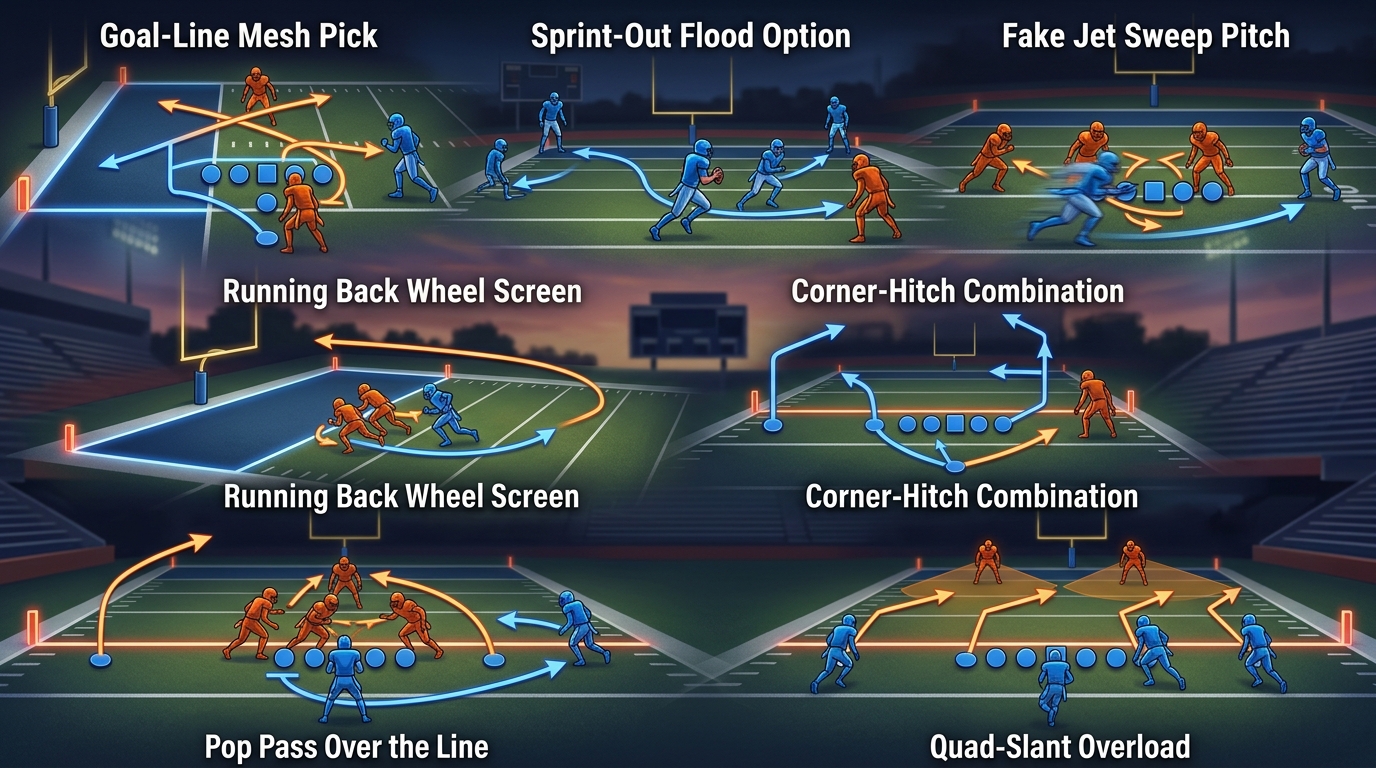
The Goal-Line Mesh Pick
Running two receivers on ultra-shallow drag routes right across the goal line creates a natural barrier that forces defensive backs into collision or delayed pursuit.
Freeing Up the Trailing Receiver
The outside receiver runs a hard slant while the slot receiver crosses under, creating a wall that strips away man-to-man leverage and leaves the second crosser completely un-guarded in the front corner of the end zone.
The Sprint-Out Flood Option
Moving the quarterback out of the pocket on a hard rollout shrinks the field even further, cutting the throw distance down to high-percentage completion zones.
Forcing the Cornerback to Commit
With a high-low receiver split along the sideline, the quarterback reads the outside cornerback instantly: if the defender stays deep, flip it short; if they drop up to attack, float the ball into the back corner.
Explosive Misdirection and Backfield Weaponry
Defenses inside the ten-yard line are hyper-focused on quick slants and quarterback eyes, making aggressive misdirection plays extraordinarily effective.
The Fake Jet Sweep Pitch
Using pre-snap jet motion draws linebackers toward the field side before turning the action back toward the weak side.
Exploiting Over-Committing Linebackers
The quarterback fakes the handoff to the sweeping receiver, freezing the defense, before flipping a subtle shovel pass to the tight end trailing quietly on a delayed leak route.
The Running Back Wheel Screen
Lining up in a heavy formation forces linebackers to play the run inside, opening up clean outer lanes for backfield receivers.
Sneaking Out to the Pylon
The running back fakes a heavy pass block before slipping past the rushing line, arching out toward the pylon for an unobstructed catch-and-run touchdown.
High-Low Vertical Concepts in Tight Quarters
Even in a condensed field, clever vertical layering forces defenders to make split-second choices between guarding low zones or protecting the back line.
The Corner-Hitch Combination
Setting up an outside receiver on a hard five-yard hitch while the inside slot runs a high corner route creates a vertical dilemma along the boundary.
Pinpointing the End Zone Corner
The quarterback delivers the ball to the back corner of the end zone right as the slot receiver turns, placing it where only the receiver can climb and pull it down.
The Pop Pass Over the Line
Faking a quick interior quarterback draw draws linebackers forward into the neutral zone, instantly exposing the space directly behind them.
Hitting the Delayed Tight End
The tight end delays for half a second to simulate a run block, then pops into the open void in the middle of the end zone for a walk-in score.
The Quad-Slant Overload
Unloading four receivers on slant routes toward the center of the end zone floods zone coverage with too many targets to process at once.
Finding the Soft Window
With four receivers cutting inside, the quarterback steps up and fires a quick dart to the third receiver in progression as soon as the first line of defense breaks down.
Leave a Reply