
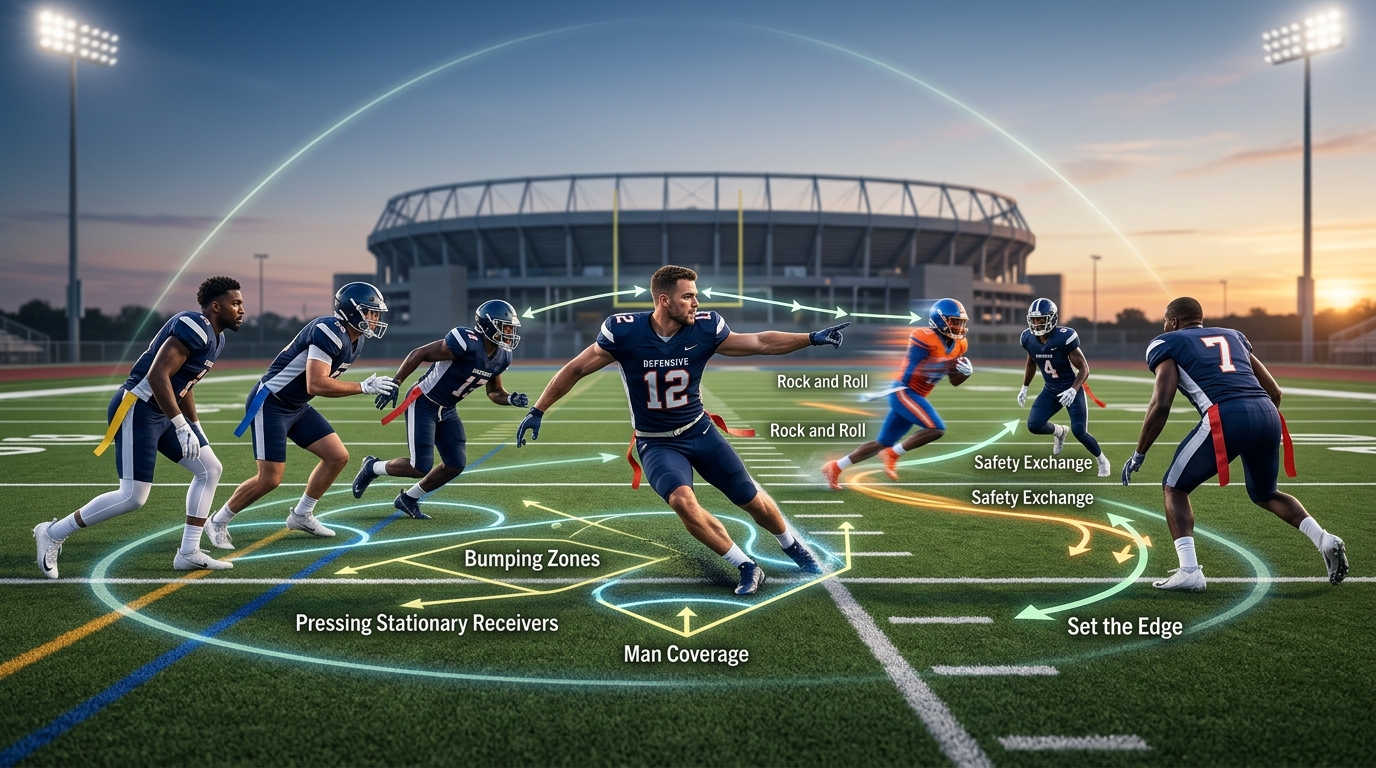
Pre-snap motion is one of the most effective tools an offensive coordinator can use in 9-on-9 flag football. By sending a receiver sprinting across the formation before the ball is snapped, offenses force defensive players to communicate quickly, reveal their coverage scheme, and shift their leverage in real time. Without a clear plan to counter pre-snap movement, defenses risk giving up easy perimeter runs and wide-open passing lanes.
Communication and Coverage Adjustments Before the Snap
Stopping motion begins with crystal-clear pre-snap communication. Every defender on the field must know their exact responsibility the instant an offensive player starts moving.
Bumping Zones Instead of Chasing
In zone coverage schemes, the biggest mistake a defender can make is chasing a motioning receiver across the field. Chasing creates massive holes in the middle of the defense and wears down your secondary.
The Slide and Shift Call
When motion occurs, defenders should communicate a “bump” call. Instead of one player following the receiver, each zone defender slides over one spot, seamlessly passing off the moving receiver from zone to zone while maintaining proper field balance.
Handling Motion Against Man Coverage
When running man-to-man coverage, pre-snap motion tests your defensive backs’ discipline, speed, and leverage.
The “Rock and Roll” Safety Exchange
To prevent a cornerback from getting rubbed out or outrun across the formation, use a safety exchange. The cornerback tracking the motioning receiver steps up to take the short flat, while a high safety “rolls” down to pick up the coverage, keeping the defense in position to make a play.
Tactical Strategies to Neutralize Pre-Snap Motion
Anticipating motion concepts allows defensive coordinators to turn the offense’s favorite weapon into a turnover opportunity.
Setting the Edge Against Jet Sweeps
Offenses frequently use jet motion to hand the ball off at full speed toward the sideline. Neutralizing this requires immediate discipline from your edge defenders.
Maintaining Outside-In Leverage
The outside linebacker or defensive end on the motion side must prioritize maintaining outside leverage. By forcing the runner back toward the center of the field, you funnel the play directly into your pursuing help defenders.
Disparity Disruptions at the Line
Offensive motion relies heavily on precise timing between the quarterback and the moving receiver. Disrupting that rhythm throws off the entire play execution.
Pressing Stationary Receivers
When one receiver goes in motion, secondary defenders can aggressively press the remaining stationary receivers at the line of scrimmage. Disruption at the line delays other route concepts, forcing the quarterback to hold the ball past their primary read.
Leave a Reply