
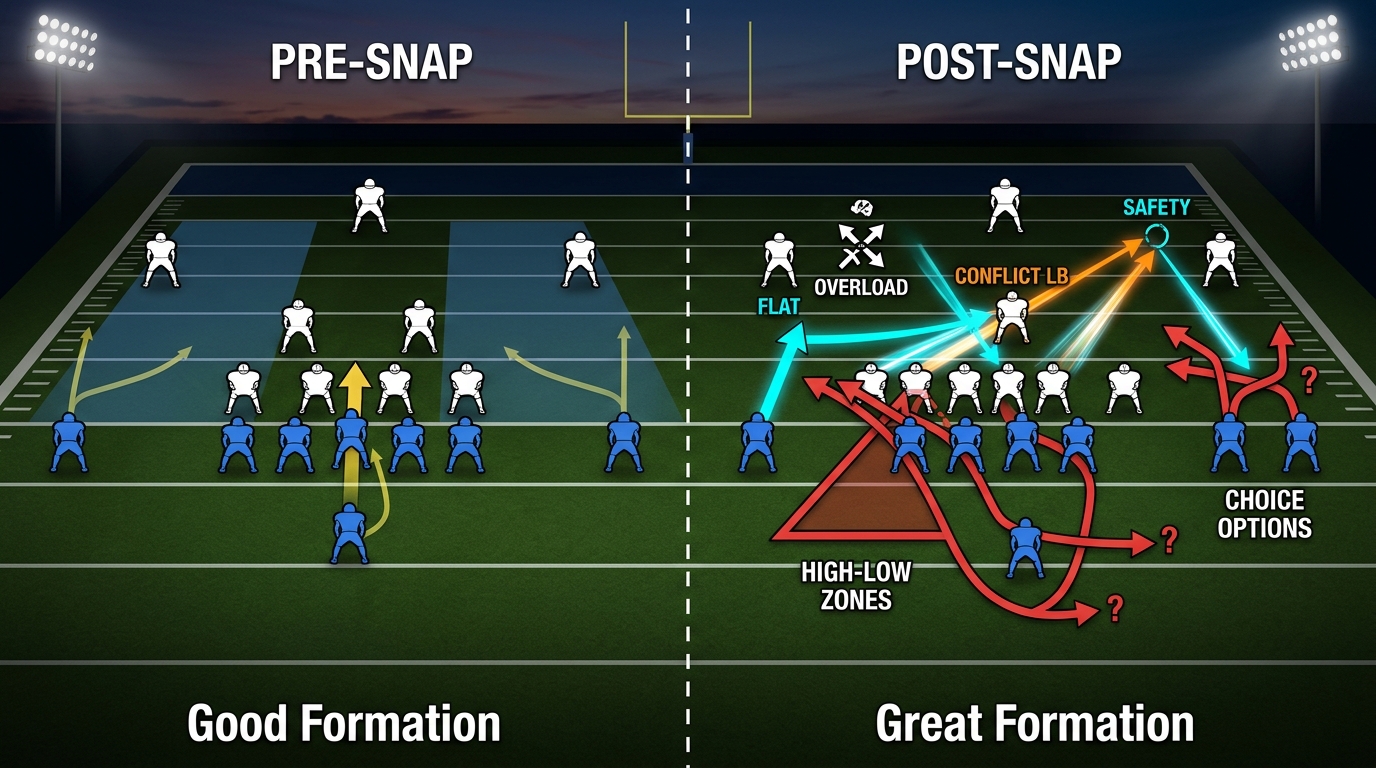
Defensive coordinators often spend hours installing complex blitz packages and exotic coverages to stop high-powered offenses, only to get burned by simple execution. However, disrupting a rhythm-based attack does not require a complete defensive overhaul. A single, subtle pre-snap adjustment can throw off the quarterback’s timing, ruin route progressions, and paralyze an entire offensive scheme.
The Power of the Post-Snap Disguise
Most modern offenses rely heavily on what the quarterback sees before the snap to make their primary reads and check into advantageous plays.
Masking Coverages Until the Last Second
When a defense lines up in a static shell before the snap, it hands the quarterback an easy map of where to throw.
Shifting from Soft Cushion to Aggressive Press
By having cornerbacks show a soft zone look before snapping into aggressive press alignment or rotating safeties right as the ball moves, the defense instantly destroys the passer’s pre-snap expectation.
Exploiting the Quarterhead’s Internal Clock
Quarterbacks operate on strict internal timers, expecting defenders to occupy specific zones based on what they observed during alignment.
Forcing Hesitation in the Pocket
When those zones shift post-snap, the passer is forced to hold the ball for an extra beat, allowing the pass rush critical milliseconds to collapse the pocket and blow up the play.
Flipping the Numbers Game in the Secondary
Offenses love to isolate defenders or create numerical advantages on one side of the field through formations and motion.
The Overloaded Rotation Tactic
Defenders can counter heavy offensive splits by sliding an extra safety or linebacker toward the strength of the formation just before the cadence begins.
Neutralizing the Quick Game
This subtle slide floods the short areas of the field with defenders, completely taking away quick slant routes and perimeter screens that the offense uses to get into a rhythm.
Baiting the Passer into Trap Coverages
Creating the illusion of an open window can trick an aggressive quarterback into throwing directly into a disguised trap zone.
The Robber Safety Technique
Leaving the middle of the field looking wide open while dropping a safety down underneath as a “robber” turns potential big gains into easy interceptions.
Breaking the Rhythm of Running and Passing Interlocks
Many offenses use play-action passes that look identical to their run schemes, forcing linebackers to bite forward.
Slow-Play Read Keys for Second-Level Defenders
Instead of aggressively crashing down to stop the run, teaching linebackers to shuffle backward slowly with their eyes locked on the quarterback’s shoulders disrupts the play-action fake entirely.
Stifling the Play-Action Window
When linebackers refuse to commit fully to the run fake, they maintain proper depth to wall off crossing routes and intermediate passing windows, rendering the play-action fake completely ineffective.
Leave a Reply