
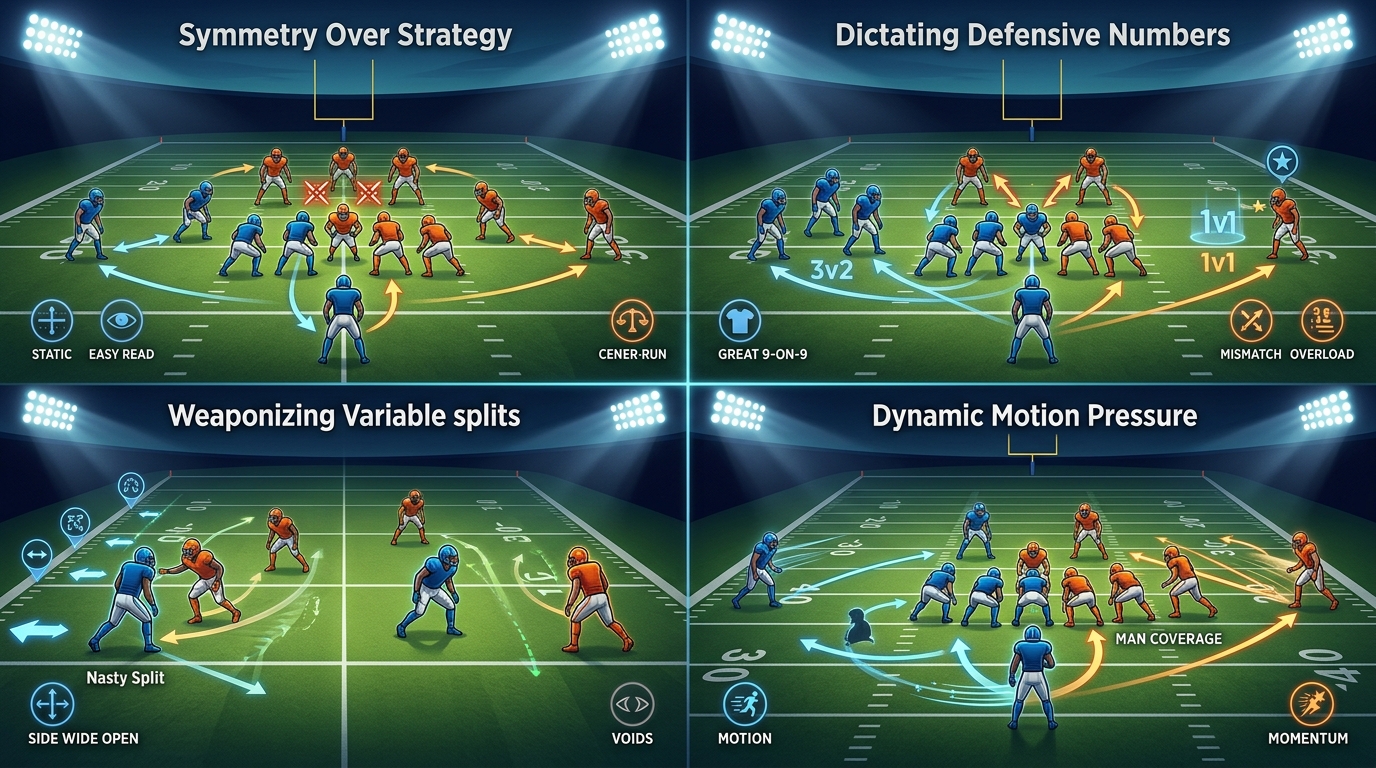
In 9-on-9 football, alignment dictates outcomes long before the ball is snapped. While a basic lineup simply gets players into position, exceptional offensive structures actively manipulate space, force defenders out of their comfort zones, and dictate the tempo of the game. Understanding the subtle nuances that separate average sets from elite ones is the key to unleashing a high-scoring offense.
The Pitfalls of Static Alignment
Average formations line players up in predictable, balanced structures that give defensive coordinators easy answers.
Symmetry Over Strategy
lining up evenly across the field allows the defense to stay in balanced coverage shells without needing to communicate or adjust on the fly.
Giving Away Pre-Snap Intentions
When receivers are spaced symmetrically with no variation in alignment depth or splits, defenders can easily guess the running lanes and passing corridors before the play even starts.
Failing to Exploit Field Boundaries
Basic formations often treat the field as a uniform surface, ignoring the massive strategic advantages provided by hash marks and wide-side grass.
Cramping the Offense to the Boundary
Lining up multiple receivers near the short side of the field condenses the defense, allowing fewer defenders to cover more players in a tight area.
The Architecture of a Great Formation
A great 9-on-9 formation uses strategic geometry to create immediate spatial and numerical mismatches across the field.
Dictating Defensive Numbers and Leverage
Elite schemes force defensive coordinators into impossible decisions before the ball is snapped by overloading one area while isolating playmakers in another.
Creating Conflict for Second-Level Linebackers
By placing three receivers on one side and an isolated playmaker on the other, the offense forces linebackers to choose between supporting coverage or defending interior run gaps.
Weaponizing Variable Receiver Splits
Adjusting how far wideouts align from the offensive tackle transforms simple route concepts into unguardable plays.
Opening Inside Passing Lanes with Nasty Splits
Bringing a wide receiver tight to the formation pulls the outside cornerback inside, creating massive voided space along the sideline for wheel routes and sweeps.
Dynamic Motion and Pre-Snap Pressure
Great formations are never stationary; they use motion and shifting to stress the defense’s communication and reveal coverage schemes.
Forcing Pre-Snap Defensive Communication
Shifting players right before the snap tests whether the defense can pass off coverage rules cleanly under pressure.
Uncovering Man vs. Zone Coverage
Sending a back in motion across the formation instantly tells the quarterback whether a defender is tracking them in man-to-man or if the defense is passing them off in zone.
Creating Momentum at the Snap
Using motion allows receivers and backs to hit the line of scrimmage at full speed, giving them a massive head start over stationary defenders.
Elevating Perimeter Screen Efficiency
A receiver coming in motion toward the flat catches the ball in full stride, turning a zero-yard pass into an explosive play before the secondary can close the gap.
Leave a Reply