
Why Flag Pulling Technique Matters More Than You Think In flag football, games are rarely won by explosive long passes alone—they are won and lost in the open field by the defense's ability to execute clean, consistent flag pulls. Many coaches focus endlessly on coverage schemes, yet a missed flag pull turns a simple three-yard gain into a soul-crushing touchdown. Mastering the biomechanics and fundamentals of flag pulling is the single most critical defensive skill on the field. ## The Biomechanics of Precision Flag Pulling Flag pulling is not an accidental grab; it is a controlled, athletic skill that requires proper body positioning, balance, and spatial awareness. ### Establishing the Breakdown Stance Closing down space without control leaves defenders vulnerable to sharp cuts and jukes from agile ball carriers. #### Mastering the Two-Foot Breakdown As a defender approaches the ball carrier, they must lower their center of gravity, chop their feet, and widen their base. This breakdown stance allows the defender to react instantly to lateral moves rather than over-committing momentum. ### Target Vision and Hip Tracking Inexperienced defenders often stare at the ball carrier's head, shoulders, or feet, making them easy targets for deceptive fakes. #### Eye Discipline on the Hips The flags are attached directly to the hips, which is the one body part that cannot fake a direction. Keeping eyes locked firmly on the ball carrier's waistband guarantees that the defender tracks the runner's true center of mass. ## Eliminating Costly Missed Tackles and Penalties Poor flag-pulling habits lead to missed opportunities, extended offensive drives, and frustrating penalty flags. ### Hand-Eye Coordination and The Tracking Hand Reaching blindly with one hand leads to high miss rates and slip-ups in high-pressure situations. #### The Two-Handed Pulling Strategy Teaching defenders to reach with both hands—one securing the hip area while the other snatches the flag stem—drastically increases the surface area targeted and lowers the failure rate. ### Avoiding Flag Guarding and Defensive Holding Reaching too high or grabbing a runner's shorts or jersey results in holding penalties that give the offense free yardage. #### Sweeping Bottom-Up Pulls Defenders trained to scoop the flag from the top of the belt down toward the bottom tail avoid grabbing clothing, executing clean pulls that leave no room for referee debate. ## Winning the Open-Field Spatial Battle Because flag football field layouts feature vast open grass, every defensive player must serve as a reliable open-field tackle equivalent. ### Pursuing Proper Leverage Angles Running directly at a ball carrier in the open field creates a two-way option for the runner to evade the defender on either side. #### Forcing the Ball Carrier to the Sideline Defenders must approach on an angle that cuts off the inside field, taking away half the runner's options and using the sideline as an extra defender to compress the space. ### Converting Flag Pulls into Defensive Momentum A defense that pulls flags on first contact dictates the tempo of the entire game. #### Creating Short-Field Pressure Consistent, early flag pulls force the offense into long second- and third-down situations, forcing predictable passing plays and opening up opportunities for interceptions and sacks.

In flag football, games are rarely won by explosive long passes alone—they are won and lost in the open field by the defense’s ability to execute clean, consistent flag pulls. Many coaches focus endlessly on coverage schemes, yet a missed flag pull turns a simple three-yard gain into a soul-crushing touchdown. Mastering the biomechanics and fundamentals of flag pulling is the single most critical defensive skill on the field.

The Biomechanics of Precision Flag Pulling

Flag pulling is not an accidental grab; it is a controlled, athletic skill that requires proper body positioning, balance, and spatial awareness.

Establishing the Breakdown Stance

Closing down space without control leaves defenders vulnerable to sharp cuts and jukes from agile ball carriers.

Mastering the Two-Foot Breakdown

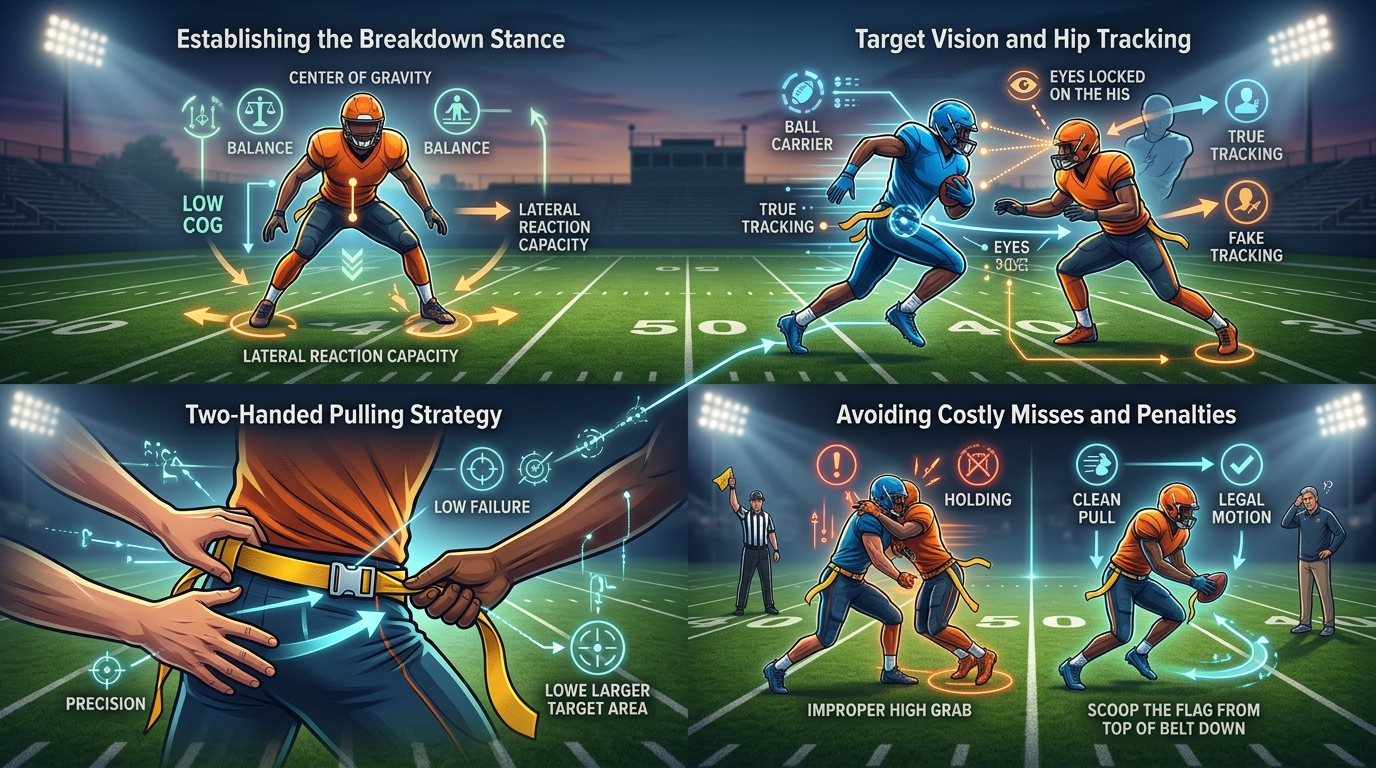
As a defender approaches the ball carrier, they must lower their center of gravity, chop their feet, and widen their base. This breakdown stance allows the defender to react instantly to lateral moves rather than over-committing momentum.

Target Vision and Hip Tracking

Inexperienced defenders often stare at the ball carrier’s head, shoulders, or feet, making them easy targets for deceptive fakes.

Eye Discipline on the Hips

The flags are attached directly to the hips, which is the one body part that cannot fake a direction. Keeping eyes locked firmly on the ball carrier’s waistband guarantees that the defender tracks the runner’s true center of mass.

Eliminating Costly Missed Tackles and Penalties

Poor flag-pulling habits lead to missed opportunities, extended offensive drives, and frustrating penalty flags.

Hand-Eye Coordination and The Tracking Hand

Reaching blindly with one hand leads to high miss rates and slip-ups in high-pressure situations.

The Two-Handed Pulling Strategy

Teaching defenders to reach with both hands—one securing the hip area while the other snatches the flag stem—drastically increases the surface area targeted and lowers the failure rate.

Avoiding Flag Guarding and Defensive Holding

Reaching too high or grabbing a runner’s shorts or jersey results in holding penalties that give the offense free yardage.

Sweeping Bottom-Up Pulls

Defenders trained to scoop the flag from the top of the belt down toward the bottom tail avoid grabbing clothing, executing clean pulls that leave no room for referee debate.

Winning the Open-Field Spatial Battle

Because flag football field layouts feature vast open grass, every defensive player must serve as a reliable open-field tackle equivalent.

Pursuing Proper Leverage Angles

Running directly at a ball carrier in the open field creates a two-way option for the runner to evade the defender on either side.

Forcing the Ball Carrier to the Sideline

Defenders must approach on an angle that cuts off the inside field, taking away half the runner’s options and using the sideline as an extra defender to compress the space.

Converting Flag Pulls into Defensive Momentum

A defense that pulls flags on first contact dictates the tempo of the entire game.

Creating Short-Field Pressure

Consistent, early flag pulls force the offense into long second- and third-down situations, forcing predictable passing plays and opening up opportunities for interceptions and sacks.

Leave a Reply

Your email address will not be published. Required fields are marked *