
Every offensive coordinator in football understands the value of a true vertical threat. A single playmaker capable of stretching the field opens up the entire playbook. However, opposing defenses spend hours designing complex bracket coverages to neutralize that threat. When a team dedicates extra resources to take away your best option, a great play designer must have a counter-strategy. The most effective systems utilize strategic alignments, pre-snap deception, and complex route combinations specifically designed to manufacture open space.
Utilizing Static Alignments and Splits
Strategic positioning on the field forces individual defenders to commit to a specific leverage, allowing receivers to win before the ball is even snapped.
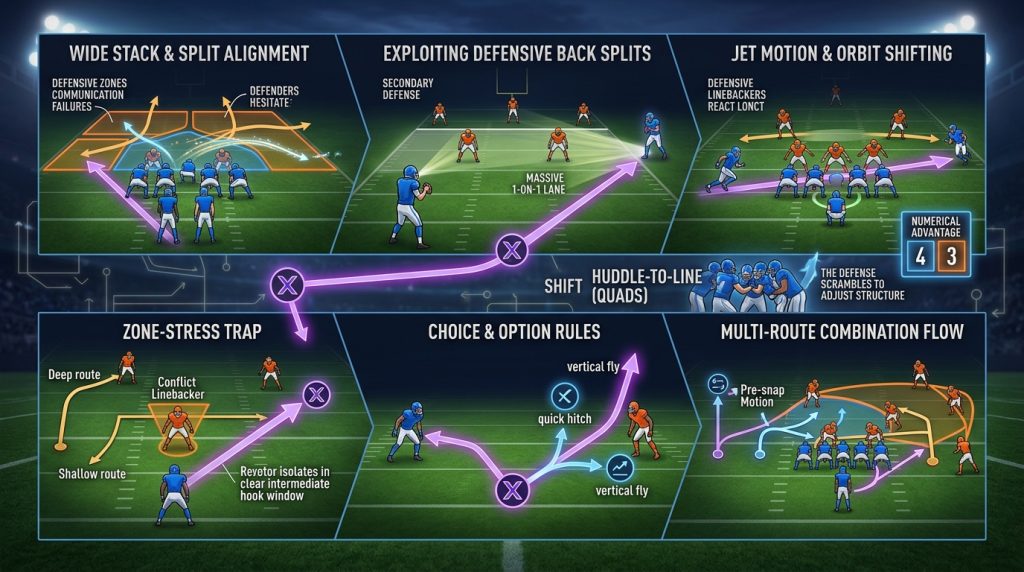
The Wide Stack and Split Alignment
Utilizing condensed stack alignments, where receivers line up directly behind or slightly outside one another, creates massive spatial confusion for secondary communication.
Forcing Defensive Communication and Bumps
This static formation stretches regional zone responsibilities. When one receiver releases inside and the top threat goes outside, defenders must make a split-second decision on who takes whom, often resulting in momentary hesitation.
Exploiting Defensive Back Field Splits
Teaching your quarterback to recognize opposing defensive back splits allows them to identify pre-snap mismatches and isolated advantages.
Checking to isolated 1-on-1 Lanes
If the defense has widened its alignment over two other receivers, a single isolated receiver side becomes a clear check option.
Implementing Pre-Snap Motion to Create Mismatches
Utilizing constant pre-snap movement forces defenses to react in real time, preventing them from sitting in comfortable coverage packages.
Jet Motion and Orbit Shifting
Moving your secondary receivers dynamically across the formation with fast jet or orbit motion draws second-level linebackers out of their primary coverage lanes.
Neutralizing Linebacker Zone Drop Lanes
Defenders who are forced to sprint horizontally right before the snap cannot drop vertically into their standard zones, creating massive openings over the intermediate center field.
Executing Clear Huddle-to-Line Shifts
Transitioning quickly from a huddle to an unexpected, unbalanced alignment—such as a Quads set—overloads defensive structure.
Creating Unbalanced Numerical Advantage Boxes
When an offense aligns in an unusual form, the defense must communicate structural changes under a severe time crunch.
Structuring Route Combinations to Force Defensive Conflicts
Multi-option play designs use complex route trees to create high-low or wide-narrow stress points on specific defenders.
Deploying the Zone-Stress Trap
Every multi-option play design must create a conflict-defender to read, often a nickel corner or linebacker, rather than just reading a zone boundary.
Combining Deep and Shallow Routes Together
A vertical route pulls a defender deep, while a shallow cross route holds them low. This high-low conflict isolates your best playmaker in a clear throwing lane on a critical 12-yard intermediate hook.
Incorporating Choice and Option Rules
Choice options allow your playmaker to adjust their release on the fly, eliminating the need for complex audibles.
Adapting Releases against Tight Leverage
If the corner plays off, the receiver breaks on a quick hitch; if the corner presses, they convert to a vertical fly route, giving the quarterback an instant win.

Leave a Reply