Defending inside the ten-yard line in 9-on-9 flag football requires a complete shift in defensive mindset. With the back boundary acting as an extra defender, safety cushions vanish, and reaction time shrinks to split seconds. Offenses rely on quick slants, rub picks, and jump balls to score, making leverage, tight communication, and disciplined goal-line technique essential to holding the line and forcing field goals or turnovers.
Adjusting Defensive Alignments for a Condensed Field
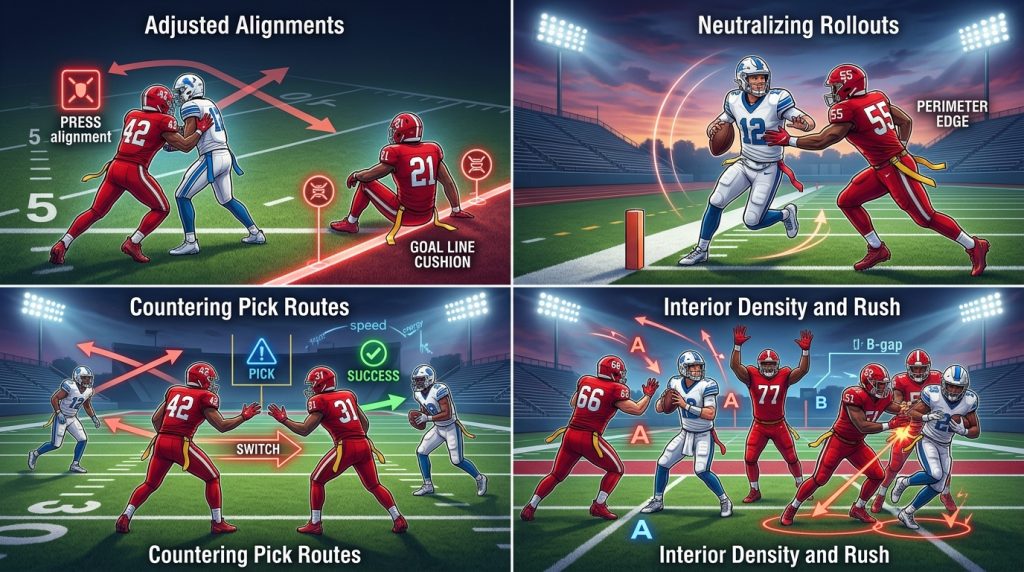
When the offense operates near the goal line, standard deep-coverage alignments become obsolete. Defensive backs must tighten their pre-snap leverage to contest fast releases.
Pressing Receivers at the Line of Scrimmage
Giving off-coverage near the goal line allows receivers easy slant routes into the end zone. Cornerbacks must align tightly to disrupt initial timing.
Jamming Releases to Delay Route Development
Jamming receivers at the snap disrupts the quick timing quarterbacks depend on, forcing the passer to hold the ball just long enough for the rush to collapse the pocket.
Shrinking Safety Cushion Depths
Safeties standing ten yards deep inside the red zone end up standing out of bounds. Secondary players must roll forward to congest intermediate lanes.
Enforcing a Hard Back-Line Boundary
Safeties should sit right on the goal line, using the end zone boundary to restrict high-low passing concepts and trap high-pointing receivers.
Countering High-Percentage Goal-Line Concepts
Offensive coordinators lean on a specific menu of plays when field space shrinks. Anticiapting these go-to concepts allows your defense to react instantly.
Neutralizing Rubs and Mesh Pick Routes
Offenses frequently run intersecting crossing routes to pick man-to-man defenders into collisions near the line of scrimmage.
Calling Automatic Pre-Snap Switches
When receivers align in tight splits, defenders must communicate a pre-snap “switch” call, swapping targets instantly when receivers cross to prevent getting caught in traffic.
Stopping Executive Rollouts and Sprint-Out Options
Moving the quarterback to the outside cuts the throw distance in half and creates dangerous run-pass options along the boundary.
Maintaining Outside Edge Leverage
The edge defender or outside rusher must set a firm perimeter, keeping their outside shoulder free to prevent the quarterback from turning the corner.
Increasing Pass Rush Aggression and Interior Density
With shorter pass routes developing in under two seconds, the defensive front must bring immediate pressure to prevent clean throws.
Sending Targeted Goal-Line Blitzes
Bringing an extra rusher off the edge forces the quarterback into rushed decisions before receivers can finish their route breaks.
Clogging Throwing Lanes with Raised Hands
Defensive linemen who cannot reach the quarterback in time must immediately break down and raise their arms to bat down low-trajectory goal-line throws.
Securing the Goal Line Against Interior Draws
Offenses often fake quick passes to slide a running back through weak interior gaps for a walk-in touchdown.
Filling B-Gaps with Linebacker Flow
Linebackers must key the center’s snap and immediately fill interior gaps, shooting low to pull flags before the runner crosses the goal line plane.

Leave a Reply