
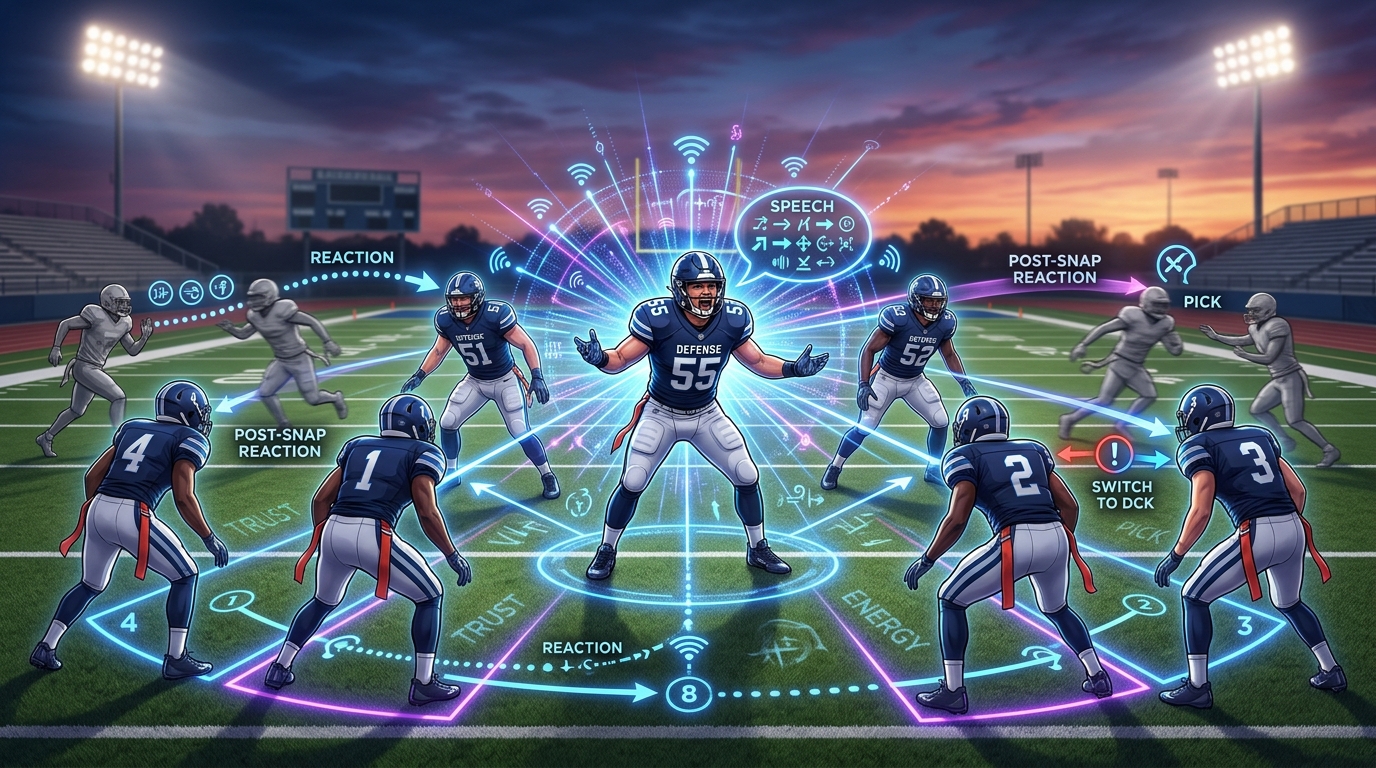
In 9-on-9 football, defense is an intricate balance between covering wide open field space and managing intermediate passing routes. While individual athletic ability and scheme design are vital, even the most gifted defenders will give up easy big plays if they operate in isolation. Clear, instant communication serves as the connective tissue that turns nine individual defenders into a single, cohesive unit capable of neutralizing modern offenses.
Preventing Costly Pre-Snap Coverage Busts
Most defensive breakdowns happen before the ball is ever snapped. Offenses use hurry-up tempos, complex formations, and late pre-snap motions specifically to force defense miscommunications and create blown assignments.
Standardizing Clear Field Calls
Establishing simple, single-word calls allows defenders to make instant adjustments without second-guessing their responsibilities.
Setting the Defensive Strength Early
As soon as the offense breaks the huddle, the safety or middle linebacker must loudly call out the offensive formation strength, ensuring the entire front and secondary shift alignment properly.
Managing Pre-Snap Motion Seamlessly
When a receiver sprints across the formation in jet motion, defenders cannot afford to guess who is picking up the moving target.
Executing Smooth Zone Bumps
Clear verbal signals ensure that zone defenders pass off moving receivers smoothly from one field quarter to the next, keeping the secondary balanced and eliminating wide-open perimeter runs.
Eliminating Post-Snap Confusion on Route Combinations
Modern passing attacks rely on crossing routes, picks, and high-low zone floods designed to confuse defenders. Active vocal communication during the play cancels out these offensive traps.
Passing Off Crossing Routes in Zone Coverage
When offensive schemes send multiple receivers through the heart of the secondary, defenders must communicate to avoid double-teaming one receiver while leaving another wide open.
Talking Through Route Transfers
Defenders must use loud, aggressive directional calls to alert teammates when a receiver enters or leaves their assigned zone area, allowing the next defender to take over coverage immediately.
Countering Rubs and Pick Plays in Man Coverage
Offenses use tight bunch formations to force man-to-man defenders into collisions with one another.
Calling Out Switches in Real Time
Anticipating contact allows defenders to call a quick “switch” before the pick occurs, letting them swap coverage targets smoothly without losing a step.
Building On-Field Confidence and Team Energy
A vocal defense plays with a level of speed and aggression that quiet teams simply cannot match. Clear communication breeds certainty, and certainty leads to fast, decisive playmaking.
Accelerating Play Reaction Speed
When players know exactly where their help is coming from, they hesitate less and break on the ball much faster.
Playing Trust-Based Defense
Constant chatter assures every player that their teammates have their back, allowing cornerbacks and linebackers to jump short routes aggressively.
Sustaining Energy and Intimidation
A defense that talks constantly, calls out plays, and celebrates together creates an intimidating environment for opposing quarterbacks.
Wearing Down Opposing Offenses
Persistent communication keeps defensive morale high through tough series, while signaling to the offense that no easy openings will be gifted throughout the game.
Leave a Reply