
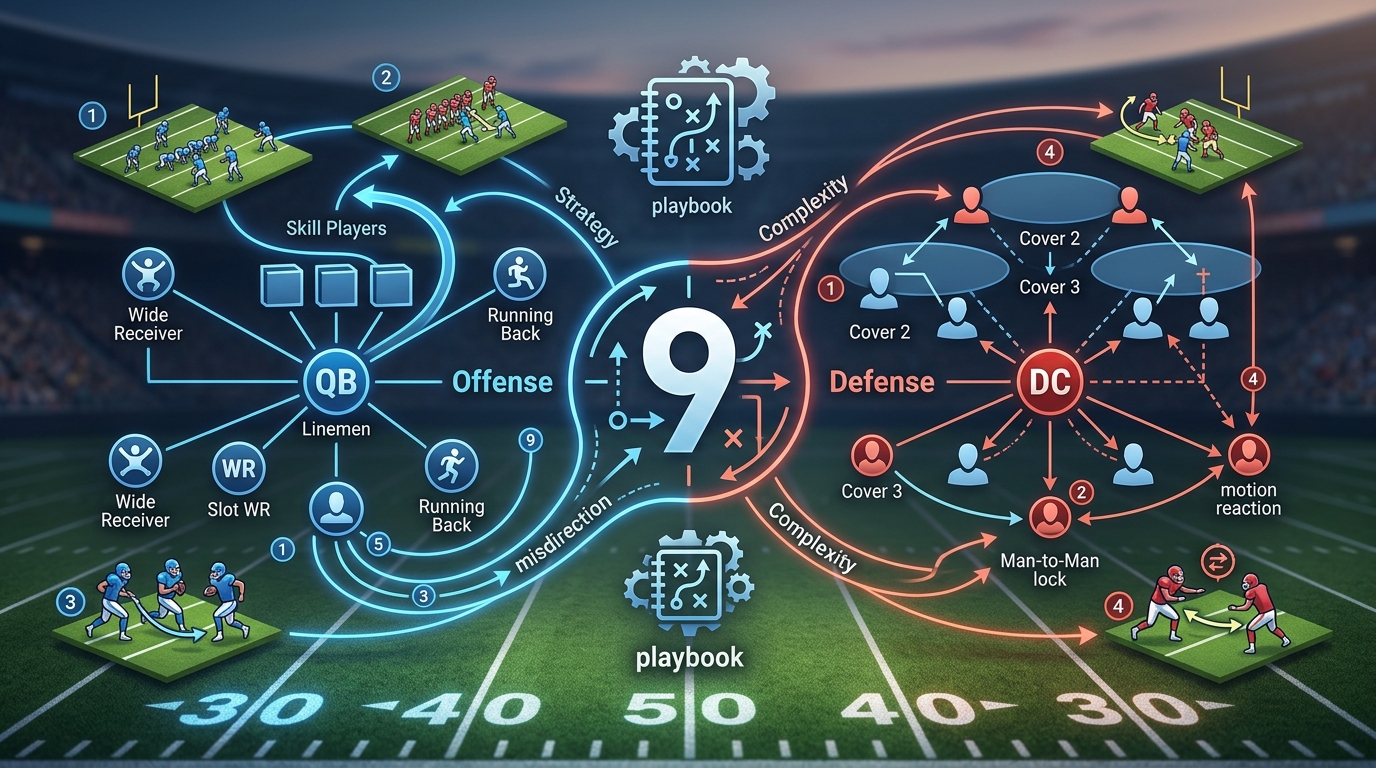
Building a complete 9-on-9 football playbook from scratch requires establishing clear structural rules that balance pass protection with perimeter threats. Unlike traditional 11-on-11 football, small-sided schemes offer unique spatial flexibility that rewards simplicity, adaptable formations, and precise execution over sheer volume.
Define Your Core Offensive and Defensive Identities
A great playbook starts with a core operational philosophy. Trying to install too many concepts overwhelms players and leads to costly pre-snap communication errors.
Establishing the Offensive Foundation
Decide early whether your system will rely on spread-and-shred passing concepts, power-running gap schemes, or option-based misdirection.
Balancing Linemen and Route-Runners
In 9-on-9 football, you typically deploy 3 to 4 offensive linemen alongside 4 or 5 skill players. Locking down your protection count ensures your quarterback always has time to progress through reads.
Setting Up the Base Defensive System
Choose a primary coverage shell—such as Cover 2 or Cover 3—that your players can execute naturally under pressure.
Standardizing Pre-Snap Communication
Create simple, one-word field calls so your secondary can adjust coverage boundaries, handle pre-snap motion, and pass off receivers dynamically without giving away position.
Structure Formations and Terminology
Clear naming conventions keep playbook installation fast and intuitive during practice sessions.
Streamlining Play Call Syntax
Keep your play calls short and structured using a logical formula: Formation + Direction + Motion + Play Concept.
Standardizing Route Tree Numbers
Use a basic 1–9 route tree system for your receivers to simplify pass progressions and allow easy on-field adjustments at the line of scrimmage.
Building Core Formations
Limit your playbook to three or four base formations—such as a balanced 2×2, an overloaded 3×1 Trips, and a compressed Bunch set—to keep defenses guessing without overloading your own roster.
Creating Modular Alignment Rules
Teach players their responsibilities based on positional concepts rather than memorizing individual play cards, making it easy to shift personnel dynamically.
Install High-Percentage Base Concepts
Focus on a lean inventory of plays designed to attack every area of the field.
Installing Core Running Plays
Design two interior runs (like an inside zone or power draw) and two perimeter runs (like a jet sweep or toss option) to keep second-level linebackers honest.
Establishing Play-Action Counterparts
Every base running play should have a matching play-action pass concept that uses identical backfield footwork to catch aggressive defenders out of position.
Developing Rhythm Passing Progressions
Incorporate high-percentage short concepts—like Mesh, Drive, and Quick Slants—to give your quarterback fast, low-risk options against tight coverage.
Adding High-Low Zone Floods
Pair your rhythm passes with three-level flood routes to systematically dismantle soft zone schemes downfield.
Leave a Reply