
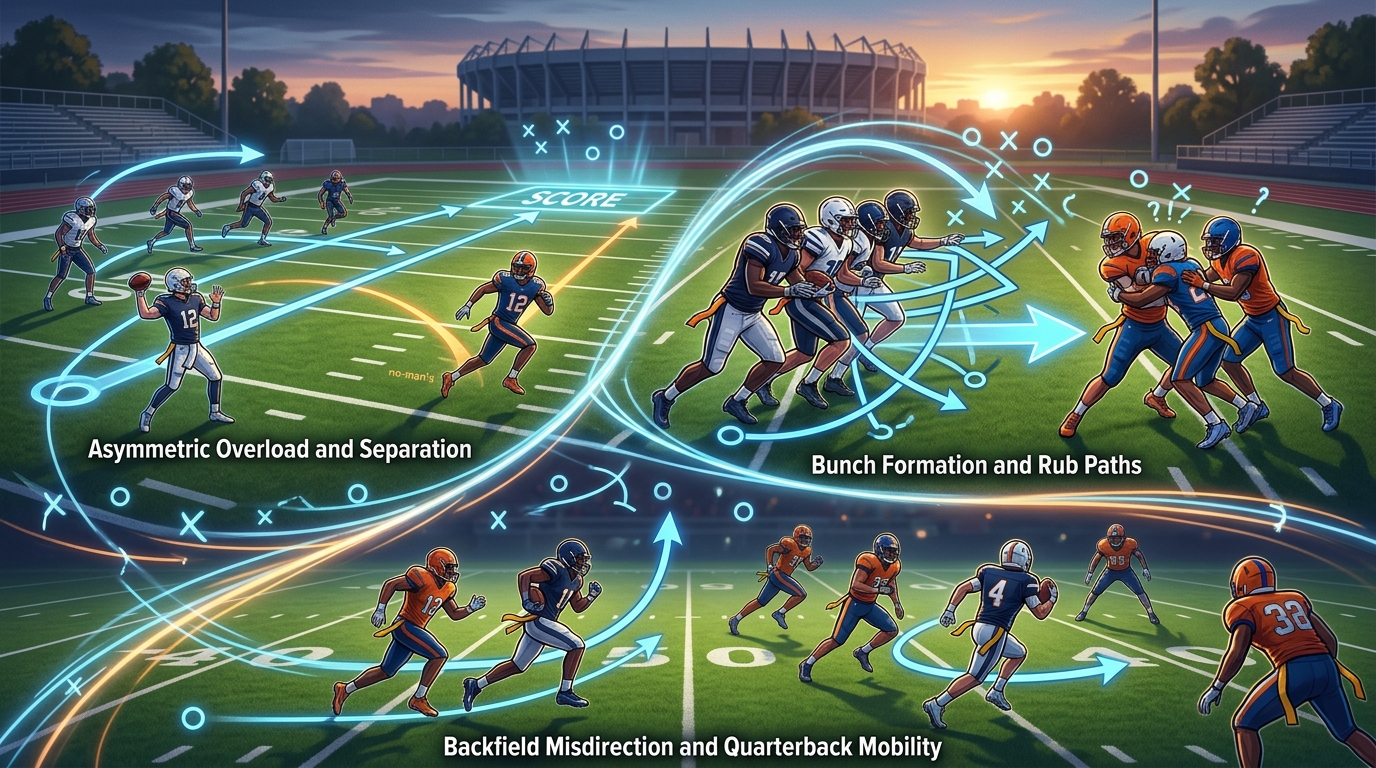
Facing an aggressive man-to-man defense in 9-on-9 flag football can feel suffocating if your offensive game plan relies solely on receivers winning isolated 1-on-1 matchups. When defensive backs shadow your receivers step-for-step, traditional passing lanes vanish, leaving your quarterback with limited options and a collapsing pocket. To defeat sticky coverage, offensive coordinators must leverage alignment, natural rubs, and deceptive route combinations to create wide-open separation.
Leveraging Alignment and Formation Tricks
Before the ball is even snapped, your formation can create natural traffic and force defensive backs into unfavorable positioning.
Utilizing Compressed and Bunch Formations
Grouping receivers closely together near the line of scrimmage condenses defenders into tight quarters, making it virtually impossible for them to maintain tight coverage without running into one another.
Creating Natural Rub Paths
When receivers run intersecting routes out of a tight bunch formation, trailing defenders are forced to navigate around oncoming traffic. This slight split-second delay gives your receiver the edge needed to pull away into open turf.
Overloading One Side with Asymmetric Sets
Shifting extra receivers to one side forces the defense to tilt its coverage, isolating defenders and creating clear lanes across the field.
Isolate Your Best Matchup on the Backside
By sending three or four receivers on routes to the strong side, you clear out the middle of the field. This allows your primary playmaker on the single-receiver side to run a slant or crosser into wide-open grass.
High-Percentage Route Combinations That Shred Man Coverage
Specific route pairings are inherently designed to beat man-to-man coverage regardless of individual athletic mismatches.
The Shallow Mesh Concept
Running two receivers on shallow crossing routes from opposite sides of the field creates a horizontal pick that decimates aggressive man defenders.
Timing the Release to Beat the Trailing Defender
As the receivers cross paths just two to three yards past the line of scrimmage, their assigned defenders must either swap coverage on the fly or fight through a wall, resulting in an easy, high-percentage completion for the quarterback.
The Out-and-Up Double Move
Aggressive cornerbacks in man coverage love to jump short routes like hitches or quick outs to make a play on the ball.
Selling the First Break to Break Free
By faking an out route before planting hard and accelerating up the sideline, the receiver catches the cornerback leaning, creating instant vertical separation for a massive downfield gain.
Exploiting Backfield Misdirection and Quarterback Mobility
Man-to-man coverage means defenders keep their eyes glued to their assigned targets, making them highly vulnerable to backfield trickery and scramble plays.
Utilizing Running Back Wheel Routes
Linebackers are rarely equipped to match the speed and agility of a running back turning up the sideline.
Outrunning Linebackers Up the Sideline
Faking a quick pass into the flat before turning the route vertically allows the running back to blow past trailing linebackers into wide-open secondary space.
The Quarterback Scramble and Bootleg Attack
When defenders turn their backs to follow receivers on deep coverage routes, nobody is left watching the quarterback.
Taking Advantage of Turned Defenders
Executing a roll-out or bootleg allows a mobile quarterback to pull the ball down and pick up substantial ground yardage before a defensive back can turn around and react.
Leave a Reply