
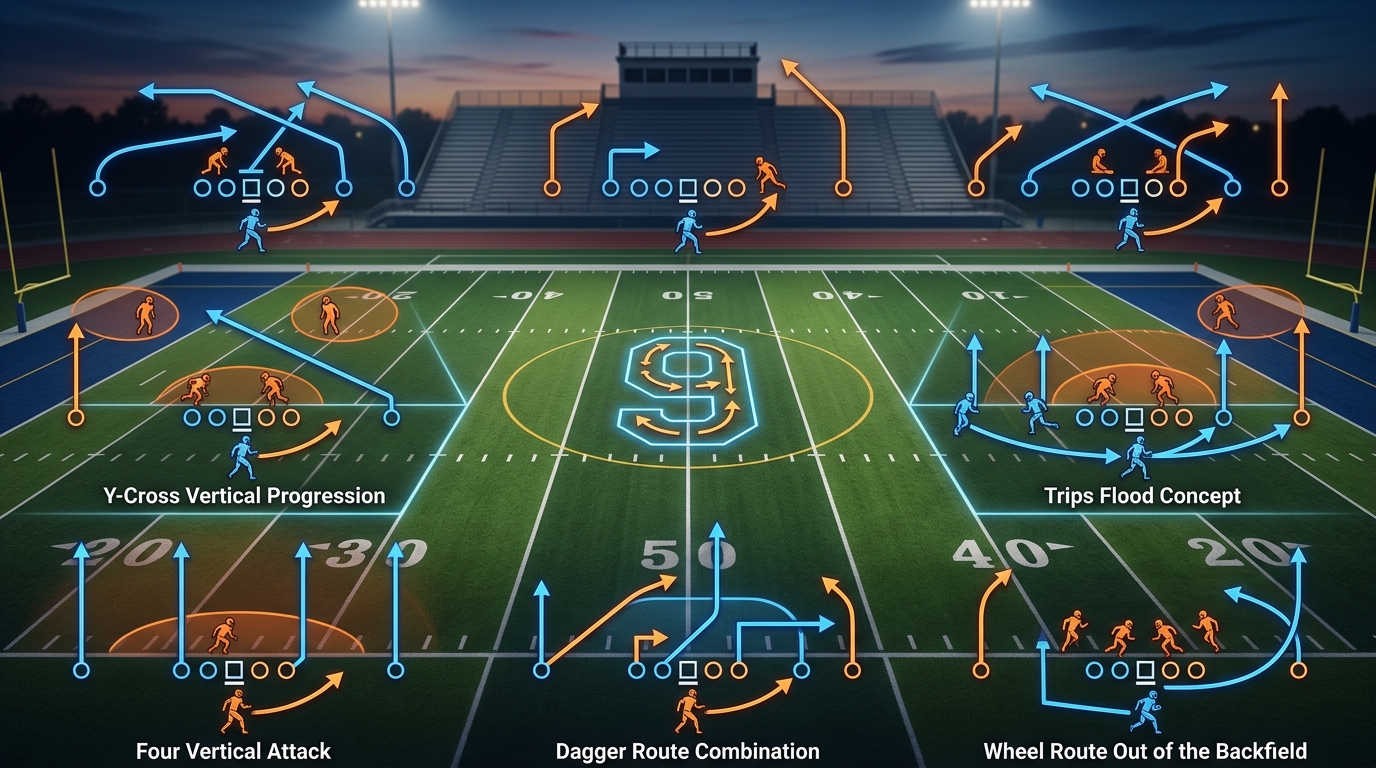
Transitioning from 5-on-5 or 7-on-7 to 9-on-9 flag football opens up a completely new tactical landscape. With more receivers eligible to run routes and additional offensive linemen offering legitimate pass protection, offensive coordinators can stretch defenses in ways that mimic full 11-on-11 football. Utilizing proven route combinations designed for extra space allows offenses to shred both man and zone coverages with surgical precision.
Short and Intermediate Rhythm Passing Concepts
Building a high-percentage passing game requires route combinations that deliver fast reads for the quarterback while guaranteeing immediate yards after the catch.
The Shallow Crosser Drive Concept
The drive concept pairs a shallow drag route from one side with an intermediate dig route from the opposite side, creating a high-low read directly over the middle of the field.
Punishing Aggressive Linebackers
As the shallow crosser draws the attention of short zone defenders, the deeper dig route opens up perfectly behind them in the soft spot of the secondary.
The Smash Concept on the Perimeter
By combining a hitch or curl route from the outside receiver with a deep corner route from the slot receiver, the smash concept puts outside cornerbacks in an impossible conflict.
Reading Outside Cornerback Depth
If the cornerback stays low to tackle the short hitch pass, the quarterback immediately drops the ball over their head to the slot receiver running toward the pylon.
The Quick Mesh Scheme
Running two shallow crossers from opposite sides of the formation creates a natural pick against tight man coverage without violating obstruction rules.
Outrunning Man-to-Man Traps
Receivers cross paths closely, forcing defensive backs to navigate around each other and giving the faster receiver a clear path into open space.
Explosive Vertical and Flood Passing Concepts
When defenses drop extra players into the short flats to stop quick passes, deep concepts isolate defensive backs and yield massive gains downfield.
The Y-Cross Vertical Progression
A deep crossing route from the tight end or slot receiver clears through the heart of the secondary, backed up by deep streak routes on the outside.
Splitting Deep Safeties
The crossing receiver cuts diagonally across the entire field, taking advantage of the wider 9-on-9 field dimensions to outrun middle safeties.
The Classic Trips Flood Concept
Aligning three receivers to one side and sending them to short, intermediate, and deep zones creates a three-level vertical stretch that overloads any zone coverage.
Overwhelming Cover 2 and Cover 3
Zone defenders cannot cover all three levels simultaneously, leaving the quarterback with an easy throw to whichever depth the defense leaves open.
The Four Vertical Attack
Sending four receivers straight downfield tests the deep discipline of the secondary, creating 1-on-1 matchups across the entire field.
Finding the Weak Link in Coverage
Quarterbacks read the safety alignment at the snap and throw to the receiver who gains an immediate step on their defender along the seams.
Deceptive and Unconventional Route Combinations
Unconventional passing concepts catch over-aggressive defenses off guard, transforming routine downs into game-changing scoring opportunities.
The Dagger Route Combination
Combining a deep seam route with a deep in-route forces safety help away from the middle of the field.
Clearing Out Space for the In-Route
The seam route clears out the deep safety, opening up a massive canyon in the middle of the secondary for the trailing dig route.
The Wheel Route Out of the Backfield
Faking a short flat pass to the running back before turning the route sharply up the sideline creates instant leverage against trailing linebackers.
Exploiting Linebacker Speed Disparities
Linebackers struggle to turn and sprint up the sideline with running backs, making the wheel route one of the most reliable big-play calls in flag football.
Leave a Reply